
The surprising emotion tied to visibility.
Earlier this month I launched our 2026 series of conversations on courage : Courageous Chutney Charcha, aptly named with a nod to the layered individuals in us and our deep cultural conditioning.
The first session focused on Visibility. Visibility as it meant to our participants:
showing up and speaking up in rooms where you feel less competent,
seeking compensation commiserate with your value,
being visibly comfortable in social and digital environments.
As we dug deeper during our charcha (discussion) visibility surfaced tethered to confidence and shame. Surprised by this connection? The lack of confidence to show up or shame associated with showing up are two intertwined but distinct layers.
Confidence is most often operationalized as self-efficacy or perceived competence whereas, shame is defined as a self-conscious emotion involving global negative evaluation of the self, not just behavior.
Brené Brown’s research demonstrates that shame erodes self-trust and authenticity, both prerequisites for confident visibility.
Even when competence exists, shame predicts lower confidence because the nervous system prioritizes social survival over performance. Shame is associated with avoidance, withdrawal, silencing and reduced initiative.
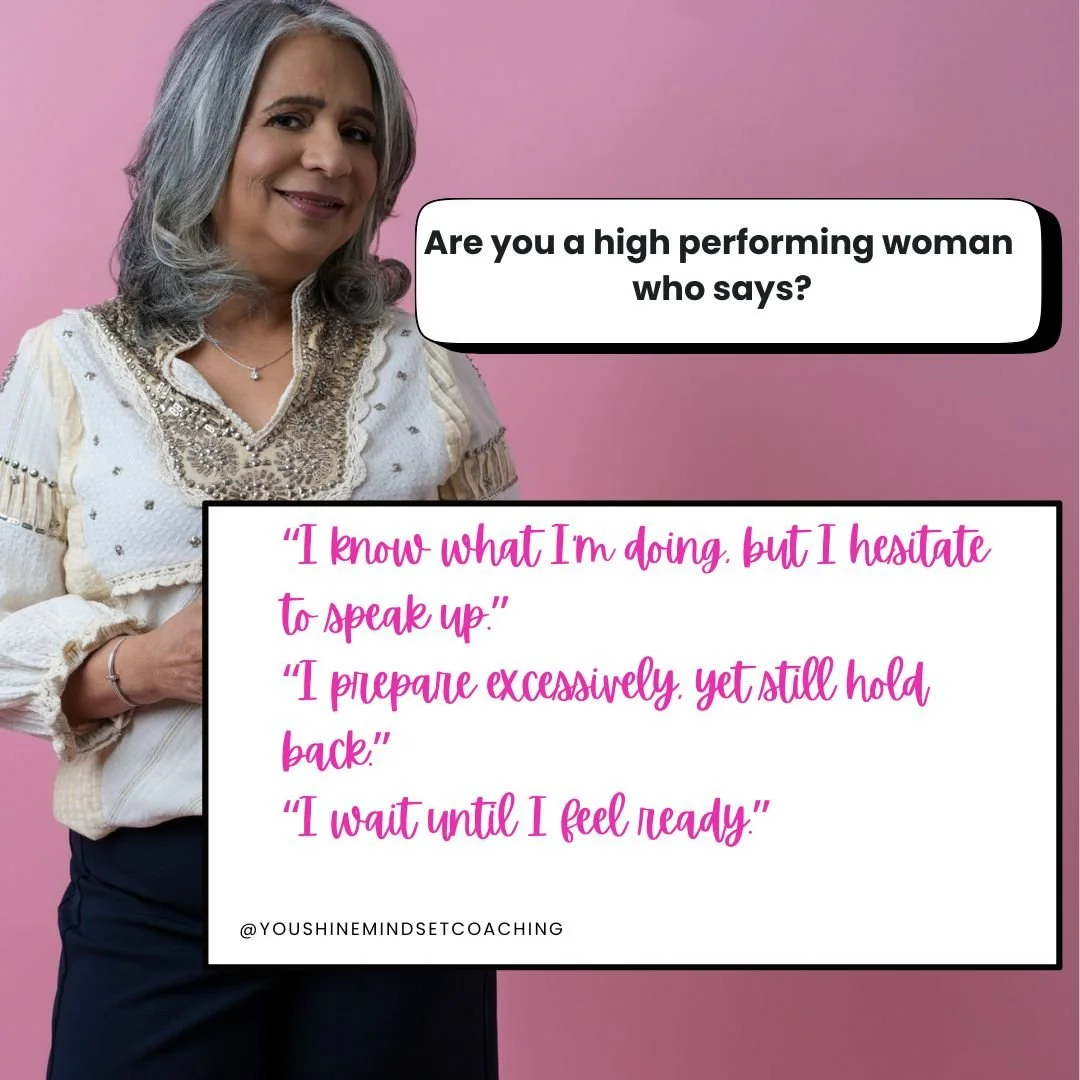
If you are a high performing woman saying:
“I know what I’m doing, but I hesitate to speak up.”
“I prepare excessively, then still hold back.”
“I wait until I feel ready.”
This is often labeled as a confidence problem. But what if it was a “safety problem”?
Psychological studies consistently show that shame sabotages confidence not by reducing competence, but by making visibility feel unsafe.
Women exposed to gendered or cultural shame norms show reduced assertiveness and leadership visibility even when competence is high.
This is why so many capable women appear less confident than they are. Not because they doubt their skills. But because their nervous system has learned that visibility comes at a cost.
Especially for women socialized and conditioned to be agreeable, modest, or not “too much,” confidence can quietly trigger shame before a word is spoken.
The takeaway matters.
Confidence does not grow by fixing yourself.
It returns when safety replaces self-judgment.
Conditioning teaches the nervous system what is safe.
Shame teaches it that being seen carries risk.
They are learned protection. And learned patterns can be unlearned.
Awareness is the beginning of that shift. It is about understanding where the story started.
If you are ready to break your belief system and go down to the root story. Book a call
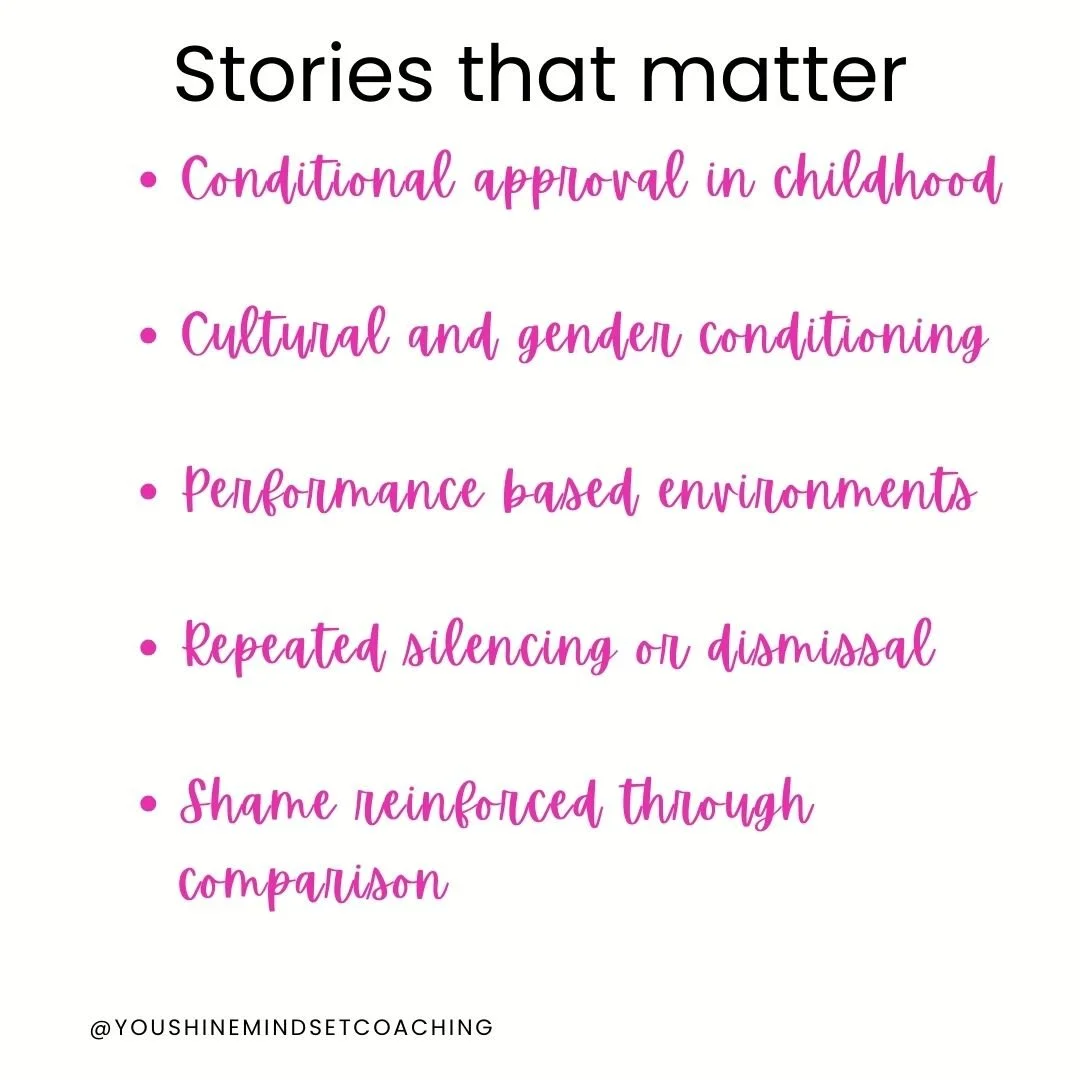
Here are some stories that are commonly printed
1. Conditional approval in childhood
e.g. You being told “don’t make a scene” or “be grateful” when you voice discomfort leads to the internalization: Some parts of me are acceptable. Others are not.
2. Cultural and gender conditioning
e.g. Being praised for endurance rather than self expression leading to: Visibility is risky. Staying small is safer.
3. Performance based environments
e.g.High achievement paired with low psychological safety could be internalized to: If I am not perfect, I am exposed.
4. Repeated silencing or dismissal
e.g. Ideas acknowledged only when repeated by someone else leading to “My voice does not matter. Better to stay quiet.”
5. Shame reinforced through comparison
e.g. Social media driven ideals of success, beauty, or productivity leading to “Others belong more than I do.”