This one is for women in science and mid-career professionals who've outgrown the assessment fatigue.
You've done them all: Myers-Briggs, StrengthsFinder, DISC, Enneagram. Your HR folder is thick with insights about your "type."
But here's what those assessments don't measure: how you construct meaning when the stakes are high.
When you're presenting to skeptical stakeholders. When you're navigating a reorganization. When you're deciding whether to speak up in that meeting or stay silent. When you're balancing a grant deadline with a family crisis.
That's not about personality traits. That's about mindset architecture.
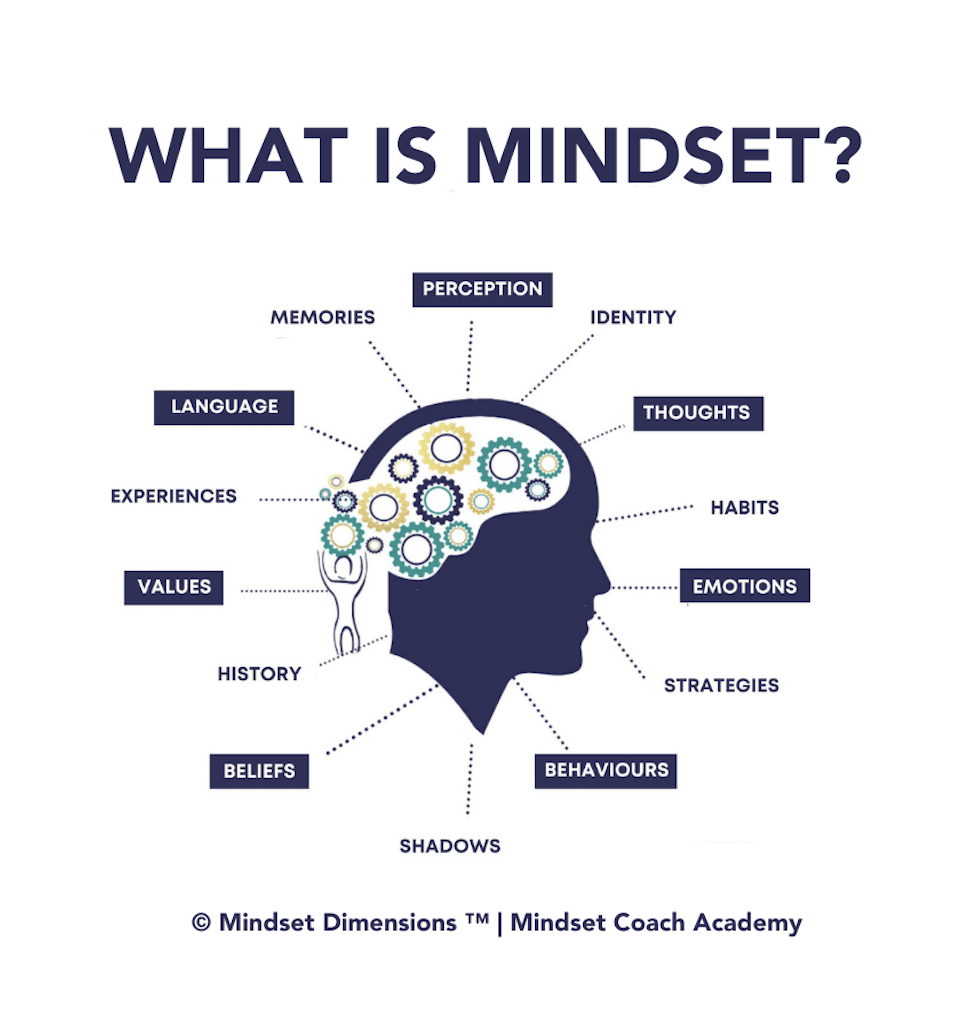
Mindset Dimensions: The Assessment That Looks Beneath Behavior
Unlike traditional psychometric tools, Mindset Dimensions doesn't measure what you think or how you behave.
It measures how you construct meaning under challenge, change, and pressure.
It's not about what you think. It's about how you think what you think.
As a mindset coach working with women in STEM and leadership, I work with clients across all dimensions of their mindset system. But today, let's focus on the one that controls everything else: Identity.
Identity: The Control Center You Didn't Know Was Running the Show
In Robert Dilts' Logical Levels framework, identity sits at the top of the hierarchy. It's the quiet operating system behind every decision you make.
It shows up in those automatic sentences that start with "I am..."
You don't change your career by tweaking habits. You change it by rewriting who you think you are.
The uncomfortable truth: If your "I am" stays the same, your results will keep hitting the same ceiling.
Shift identity → your beliefs realign
Beliefs shift → your standards change
Standards change → your actions follow
Actions repeated → become your new environment
Identity is not a layer of growth. It is the lever that moves all the others.
But Identity Isn't Something You Just Choose
Identity isn't the power suit you wear to feel confident. It isn't a vision board exercise.
Identity is shaped by:
Lived experiences (especially early ones)
Meaning-making patterns (how you interpreted what happened)
Cultural conditioning (what you absorbed about who you "should" be)
For women in science and technical fields, this conditioning runs deep. We absorbed messages about being:
Grateful (for being "allowed" in the room)
Modest (don't appear "too much")
Selfless (your needs come last)
Palatable (don't be "difficult" by having boundaries)
Do Any of These "I Am" Statements Sound Familiar?
If you hear yourself say:
✗ "I am supposed to make everyone happy"
✗ "I am not strong enough for this level"
✗ "I am selfish if I prioritize my research/career"
✗ "I am a caregiver first" (when this limits your entire identity)
✗ "I am not good enough" (despite the PhD, the publications, the promotions)
✗ "I am difficult" (for having boundaries)
✗ "I am invisible" (especially in meetings dominated by men)
✗ "I am an imposter here"
These are culturally conditioned identity statements—not truth.
What Empowered Identity Actually Sounds Like
Not all identity statements are limiting. Here's what shifts when you do the deep work:
✓ "I am strong and capable"
✓ "I am worthy of respect—not because I proved it, but because I exist"
✓ "I am free to choose what serves me"
✓ "I am empowered to set boundaries without explanation"
✓ "I am authentic and unapologetic about my expertise"
✓ "I am a scientist who honors her needs"
✓ "I am resilient and adaptable"
✓ "I am connected to my inner wisdom—not just external validation"
✓ "I am enough, exactly as I am"
"Can't I Just Use Affirmations to Shift Identity?"
I wish it were that simple.

Affirmations work at the conscious level. They're like planting seeds on concrete—they sound good, but if your subconscious beliefs contradict them, they won't take root.
If you've spent 30 years thinking "I'm not leadership material," repeating "I am a leader" might trigger an inner voice that says "Yeah, right."
That's your subconscious calling BS. And it usually wins.
Why? Because 95% of your brain's processing happens subconsciously.
Affirmations work on the 5% surface level. They can reinforce change—but they can't create it alone.
“What might your deeper identity look like? How does an identity shift begin, and what supports it along the way? If this resonates, you may be ready to explore an identity shift of your own.”
Ready to Map Your Mindset?
If you're a woman in science or mid-career leadership who's done all the personality assessments and still feel stuck at the same ceiling, it's not about learning more strategies.
It's about examining the operating system that's been running the show.
Let's talk about what deep mindset work could look like for you.
